Thursday, August 21, 2014

Attack of the Social Media Zombies

My colleague, Matthew Durington, and I have just finished our final iteration of a 4-year collaborative project, Anthropology By the Wire.   From the outset, we sought to produce
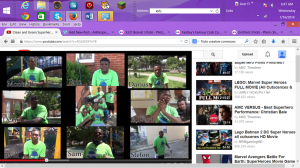
YouTube Video from this year's Anthropology By the Wire, "Clean and Green Superheroes". Photo courtesy of Samuel Collins.
YouTube Video from this year’s Anthropology By the Wire, “Clean and Green Superheroes”. Photo courtesy Samuel Collins
counter-narratives to David Simon’s “The Wire,” alternative representations that contest urban imaginaries of Baltimore premised on crime and drugs.  Through collaborative productions shared through social media, we have tried to challenge the directionality of these representational regimes by making local media disseminated on YouTube, Tumblr and Flickr.
But what we have realized is that the urban imaginary (as LiPuma and Koelbedescribe it), is constituted not only by representations of urban circulation, but the imagination of the circulation of those representations of circulation (and it may be circulations all the way down).  In other words, it is not only the representations of the city that allow people to understand themselves and others, but the way people imagine that those representations circulate.
As mass media, “The Wire” (and other television and film evocations of the city) is imagined to circulate through an audience: a mass that desires and consumes media, that can be characterized by demographic analyses, and that, finally, can be packaged and sold to advertisers.  It’s the imagined gaze of that homogeneous “mass” that has been so devastatingly effective in slotting Baltimore as “Other”: as a racial and class alterity that becomes the subject for critique and intervention.
Photo courtesy Kamau Collins
Stereotypical Spectacles of Baltimore: Abandoned Industry. Photo courtesy Kamau Collins via Flickr
In many ways, this idea of mass audience has been profoundly challenged by the widespread adoption of social media; to some media scholars, we are all “prosumers” now.  But the social media platforms that communicate our work draw upon other circulation imaginaries.

The Spectacle City

The first is an extension of the flanerie that marked the city as a site of male privilege a la Charles Baudelaire.  In the postmodern logic of late capitalism, this means the city as an extension of individual identity.  In his prescient Soft City (1974), the writer Jonathan Raban put it best: “Decide who you are, and the city will again assume a fixed form around you.”  In other words, the city exists as a foil for the elaboration and construction of one’s identity.  Raban’s Soft City is echoed in countless films (Ferris Bueller’s Day Off) and endless postmodern spectacle, where the city becomes a site for personal consumption and successive elaborations of commodified identity.
Social media has been erected on this capitalist scaffolding.  First, social media is ultimately personal social media—the city as an object for individual consumption on instagram and pinterest.  With social media, life may be constituted as “an immense accumulation of spectacles” (a la Guy Debord), but those representations are inward-focused, with the spectacle of the city laid out as a buffet of representations to take and share with a circle of intimates: pictures of lunch and dinner, of urban desolation, street festivals, alternative fashion.  Superficially ethnographic, each of these images and videos are mobilized as a projection of self to a cluster of acquaintances.

The Contagious City

Photo courtesy of jpellgen.
Crab Cakes. Photo courtesy jpellgen via Flickr
Alongside the privileged flanerie of the 19th century city came panics over pollution and contagion, with the 1864 Contagious Disease Act targeting the poor and dissolute as sources of “pollution” to the flanerie of upper-class men.  Today, theories of “contagion” are deployed epidemiologically, but they are also utilized to represent the spread of information in networks, the spread of crime in cities (the “broken window” theory) and in the virality of social media.
In each case, the question of contagion becomes a network problem.  In any cascade of information, disease, new technologies, new ideas, what percent of a given social network configuration needs to be “infected” before it can spread to the remainder?  When media go viral, they have passed this cascading “tipping point,” and a number of network scholars are currently examining the morphology of networks for clues to the virality of content.
Photo courtesy Nick Hall
Zombies during the Baltimore Marathon. Photo courtesy Nick Hall via Flickr
Although contagion seems like the opposite of the individuated consumption of the city, it is really its logical counterpart, with each individual first atomized into her own media telecocoon before influencing her neighbors.  It’s not by mistake that zombies have become such a ubiquitous figure in social apps and movies about the city.  If I imagine myself as active in my individualized consumption of the spectacle of the city, than everyone else can only be a zombie, a node through which my influence propagates.  In other words, as a form of circulation, we imagine social media to be composed of individuals and zombies: people who tweet, and people who propagate that tweet.
For our social media circulation of Baltimore, we therefore imagine not only media producers (those who represent Baltimore and share their representations on social media), “consumers” (those who watch the media we’ve produced), but also this interstitial category of social media zombies that pass along the links to our YouTube media and blog posts—who do the work of network propagation.  In this respect, much of our social media tagging can be considered varied forms of zombie food: keywords that encourage re-posting and that stimulate networked cascades.  Tagging your photo “urban ghetto” precipitates one form of contagion, while tagging the same shot “gentrification and abandonment” generates quite another.  Yet these lines of contagion are only possible in the imagined circulation of individual consumption and, in the end, we need to be mindful of our zombies lest they overtake us altogether.

The Ends of the Urban Imaginary

The last scene of Akira shows Tetsuo exploding out of his body with tendrils of flesh and machine.  Often interpreted as an apocalyptic, nuclear vision of Tokyo, it is simultaneously one where the differences between people and between places are eviscerated: Tetsuo’s monstrous appendages engulf his friends and enemies, traduce geographies, brachiate uncontrollably through Tokyo.
For me, Akira is a metaphor for the limits of our imaginaries of circulation.  It’s the ends of these two imaginaries—the individual spectacle and the contagious zombie—pushed to their limits until social media itself has become something monstrous where the city, the individual and the community disappear into circulatory flows.  In these scenarios, new configurations of the circulatory imaginary implode into non-representation.  Do we have an alternative?  Ultimately, our efforts to replace one circulatory imaginary with another—as Bruno Latour and Marilyn Strathern have shown—will ultimately produce more monstrous imaginaries.  Who will save us from our zombies then?
(Second photograph courtesy Kamau Collins; Third photo courtesy jpellgen; Fourth photo courtesy Nick Hall)
[Originally Published in Anthropology News]

Friday, June 20, 2014

Poor Data, Rich Data, Big Data, Chief

Over the past 2 years, Big Data has worked its way into public consciousness, courtesy of widespread news exposure and a series of popular books by Big Data scientists with hyperbolic evocations of the analytic power of their methods.  There seems to be nothing that Big Data cannot do: predict health and wellness, illuminate culture change, stop poverty, foil terrorists.  And, of course, tighten the noose of Foucauldian surveillance from governments and corporations.  But what all of these accounts promise (or threaten) is a transparent window onto truth: our social lives, behaviors, hopes and dreams all rendered transparent through the analysis of vast datasets.
Visualization of all editing activity by user. Image courtesy Fernanda B. Viégas and wikicommons
Many qualitative researchers—including anthropologists—have sounded an alarm over this drive to datafictaion, where, as Chris Andersonhas famously concluded, “numbers speak for themselves.”  If Data Scientists can tell us what everyone is doing and what everything is thinking, what need is there for 60 in-depth interviews and two years of participant observation?  As Tricia Wang asks, “What are ethnographers to do when our research is seen as insignificant?”  What are we to do, in other words, when community relationships that we painstakingly elucidate over months of field research can be scraped from social media in a few minutes?
For Wang, the answer is to engage Big Data—and to make ethnographic research relevant in a world of hyper quantification.  Dana Boyd and Kate Crawford (2012) make some of the same points, additionally going on the offensive by exploring the assumptions underlying the drive to Big Data.  Do numbers really speak for themselves?  And does having all the data mean that you have privileged access to all the facts?
But these questions should be familiar to cultural anthropologists; we are no strangers to Big Data.  While we haven’t generally dealt with millions of data points, the hyperbolic claims of Big Data echo the hubris of anthropology in its contact with small societies.  By looking back on these earlier methodologies, we might reconceptualize Big Data as another chapter in what Walter Mignolo has called the “enduring enchantment” of modernity.
In 1898, Alfred Hort Haddon and his team (which included Charles Seligman and W.H.R. Rivers) set out on an expedition to the Torres Strait islands off the coast of New Guinea.  With broad goals for their field surveys, including salvage anthropology, experimental psychology, linguistics and physical anthropology, the team quickly amassed huge amounts of filed data—enough for 6 huge volumes.  Along with these compendia, the team additionally developed novel methodologies, with W.H.R Rivers’s “genealogical method” being the best remembered (as well as the most excoriated).
In order to compensate for his ignorance of native languages, and for the shallowness of the expedition’s contact, Rivers began asking people (in pidgin English and through interpreters) for the names of their “father,” “mother,” “husband,” “wife,” etc.—never mind that these terms were a priori mired in his British, middle-class assumptions about filiation and descent.  Surprised by the impressive, genealogical memories of his informants, he was able to generate vast amounts of “data” using this ham-fisted approach, including “complete” records for some the islands the Torres Straits team surveyed.  From that data, he was able to generate numerous insights into marriage, naming practices, fertility, “totemistic systems,” and even history and culture change.  In other words, without engaging people in real conversations about their lives, and without actually observing islander life, Rivers believed he could apprehend the “whole” of Torres Strait culture and society through applications of his “concrete” method.
The Genealogical Method of Anthropological Inquiry by  W. H. R. Rivers, 1910. Image courtesy the Sociological Review
The Genealogical Method of Anthropological Inquiry by W. H. R. Rivers, 1910. Image courtesy the Sociological Review
Big Data starts from any of the same assumptions.  Without direct windows onto people themselves, Big Data scientists harvest proxy data from the residue of our complex lives in information society.  Do you want to know if people are getting sick?  You could ask people—and observe their behavior—but you could also (as with Google Flu Trends) compile search data on symptoms.  Or do you want to know about the mobility of people in cities?  You could interview people and follow them are their daily round, or you could, as Barabasi and his team did, analyze the billing records from 100,000 cell phone users in order to generate maps of movements over a 6-moth period.
Is it specious to compare huge datasets from Google with Rivers’s collected genealogies?  Both proceed from the same assumptions about the whole.  After all, anthropological research on small populations of people living in putative isolation on islands was premised on the assumption that one could collect and understand everything about a simple society.  Big Data builds a similar edifice upon massive computing power and the integration of networks.  For Google, flu trends provides a window onto vectors of illness because it collects the whole of Google search data—an island, as it were, secured by a near-monopoly over Internet traffic.   In addition, the problems of the genealogical methods are the problems of proxy data in general.  Massive data can be collected, analyzed  and correlated, but what do these data describe?  When Rivers asks the Torres Strait islanders who their “proper” father is, how useful are those data?  And if he’s managed to solicit genealogies out to five generations, what insights might he derive from these facts?
Of course, big data scientists debate the suitability of data proxies—but it would be a mistake to assume that we have nothing to add to that argument.  Moreover, anthropologists have a long history of questioning the synecdochic fallacy.  Is kinship the foundation for society?  Can we understand the whole of society by considering key institutions like kinship, subsistence and exchange?  And what does it mean to understand the “whole” to begin with?   These are ultimately the questions to pose Big Data: if I collect all of the tweets (as the Library of Congressis doing), can I now understand how people live in the city?  Or how they relate to other people?  Or is there always some destabilizing meaning that lies between these hundreds of terabytes?
Most of all, we can utilize our own experiences to reflect on Big Data as a technological imaginary.  Why do we think it’s desirable to collect all of the data?  What do we imagine the truth of the whole to be?


Book Review of "Making Peace With Nature: Ecological Encounters Along the Korean DMZ"

This is somewhat belated given the publication date, but Kim's book is theoretically suggestive and a great example of multispecies work...