Moving Across Scale and Platform in Seoul
Walker, Rider, Smartphone Talker
In Ryu Shin’s 2014 Seoul Arcade Project, the author, in the persona of the “walker” (구보), explores Seoul through Benjamin’s “Arcades Project,” focusing on the phantasmagoria of Korean capitalism and spectacle over the course of a day’s travel from Gangnam to Gangbuk and back again. That said, there are some significant differences between Ryu’s project and Benjamin’s, notably in the presence of two technologies altogether absent from Benjamin’s unfinished masterpiece: the smart phone and the subway.
More than just communication and travel, Ryu’s subway and smartphone combination fuels his narrator’s journey across multiple forms of transit to Seoul’s diverse spaces. Here, the project is a renewed call for analyses of urban mobility systems, but not only that—it’s a call to look into the ways urban practice involves this assemblage of movement, technology and communication. The challenge for anthropology is to be able to nimbly navigate these networked trails.
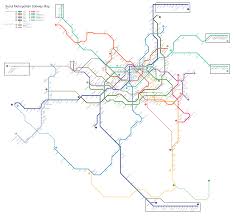
Seoul Metropolitan Subway, from Wikipedia Commons
The 1980s called, and they want their Cyberanthropology Back
In a curious artifact of the 1980s, anthropologies of digital life tend to concentrate their attention on those technologies to the exclusion of other technologies, relationships and spaces. When they interview their interlocutors, it is in relation to those selfsame technological platforms: “What do you think about blogging”? And yet, it seems obvious that life is lived across platforms, and nowhere more so than in our urban perambulations.
The idea of our networked lives as a complex assemblage is nothing new in Korea. After a relatively slow start in the 1980s, college students began rapidly acquire beepers (삐삐) or, more formally, 무선호출기. Each subway or bus station had lines of payphones for people who had received a page to call and (hopefully) rendezvous with their friends. That is, the system worked in combination: telephone-beeper-subway-telephone. Although the few, remaining payphones in subway stations are a curious anachronism, the smart phone-subway combination is the undisputed heir. This is nowhere more obvious than in the adoption of Wibro (Wireless Broadband) on Seoul’s subways in 2009, an inestimable public service which provides free WiFi and, in the process, fuels the formation of new systems of digital mobility and communication.
Boarding the Hell Train
Let’s consider what’s often called the hell train (지옥철)—Line 2 of the Seoul subway. It circles the downtown area, bringing crushing crowds of commuters and general despair. Diving down a little deeper: Seoul City Hall Station lies on both Line 1 and Line 2. It is also sits at the cross-roads of politics, tourism and culture in Seoul—next to plazas, palaces, Korean chaebol, embassies, etc. It lies on
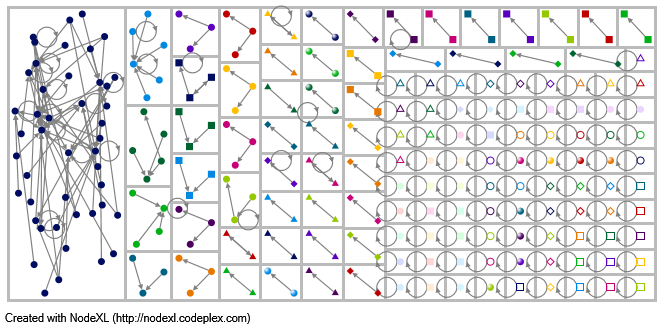
Tweets made between October 16 and 19th mentioning “City Hall Station”
the Sejong-no—and in doing so maintains a link to the city’s beginnings in the Joseon dynasty as well as its occupation by the Japanese and by the U.S. (the old City Hall was built during Japanese occupation). It is also the subject of countless tweets.
Like most twitter graphs, the different components—comments, fragments of conversation–are unconnected, the thoughts and missives of people literally passing through. Nevertheless, we can broadly characterize these tweets by their frequency:
| Tweet Content | Number of Tweets |
| Events and happenings near the station | 86 |
| Characteristics or incidents at the subway station | 27 |
| Transferring at the station | 16 |
| People and incidents on the train | 14 |
| Meeting at the station | 8 |
| Restaurants near the station | 8 |
| Passing the station (while walking, driving, etc.) | 8 |
| Meeting near the station | 3 |
What’s interesting here: the lion’s share of tweets takes people outside of the station to meet people in physical spaces. That is, twitter combines with the subway to facilitate an encounter or a meeting outside of the station in the city.
One of the small clusters of tweets (in the upper, right-hand corner) is for a particular meeting: the “시청역 동네잡지/ 시청역의 점심시간” (City Hall Station Neighborhood Magazine/ Lunch Time at City Hall Station). The neighborhood magazine started with its editor’s (Hyeong-jeong Kim) curiosity. As she explains to Hangyoleh21 Magazine, “[I wanted to know] the faces and the stories that these people that you pass quickly every day at the subway station on their way to buildings in this area and back again.” After initial meetings for lunch, they decided to start making a neighborhood magazine with contributions from people who rode the subway together and worked in the same neighborhood: familiar strangers of the city.
Kim started organizing meetings on Facebook, announcing meet-ups, deadlines and new issues to people who had “liked” the page. In this graph, the different clusters (represented by different colors), are each linked to different issues of the magazine and to related events, including calls for participation, meetings, classes, production and publication announcements: the posts succeed each other likes waves radiating different centers to reach a diverse group that includes the core team members, contributors, and members of the community including people overseas.
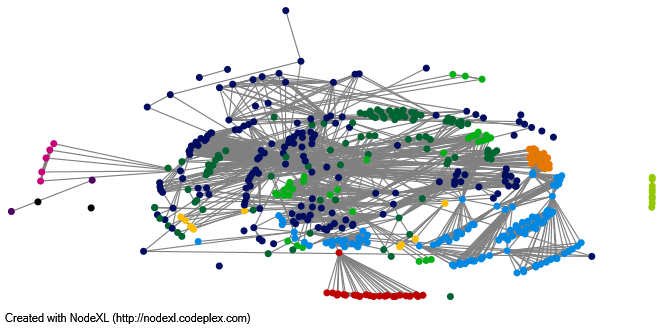
Graph of Facebook Community page showing co-likes and co-posts
Each magazine issue features prose and poetry from contributors that ranges from thoughts about restaurants around City Hall Station (“People Feeding You Around City Hall Station”) to meditations on summer trips (“My Summer Vacation”). The upcoming issue, “Patronage” (단골), takes readers into area coffee shops, restaurants and bathrooms (“Grading City Hall station bathrooms by order of priority”).
In addition to the magazine content, networks extend from this work to the different restaurants and coffee shops where the magazine is being distributed, to area non-profits who are affiliated with the magazine through their website or their Facebook page. The network begins broadly, contracts to a point, and then expands again in the creation of new edges and new nodes—the digital rhythm of life in a networked city.
Where Digital Scholars Fear to Tread
When we’re looking at social media, the tendency is to just examine the social media. And yet, the examples here form complex systems that include space, mobility and digital communication: an actor network made up of subway + subway station + twitter + face-to-face meetings + Facebook + physical magazines and, like Line 2 of Seoul’s subway, back again. The jumps in scale and platform are not, I would submit, incidental to this process: they trace social action in a complex environment made up of varying systems of mobility, social connection and communication. This is a trail only an anthropologist can follow. Accordingly, next steps for this research include interviews and observations of everyday life–for these are ultimately the quotidian ways we organize our lives in a networked world.
[This post originally appeared in Anthropology News].


