The Spatial Practice of Online Social Networks
What are the relationships between the city and the social media used in the city? I assume that social media have had an impact on the ways we relate to the city. This, after all, was one the goals in utilizing Twitter in #Occupy protests—to organize people in space. During those protests, social media helped evoke alternatives to hegemonic spaces structured by capital flows. On the other hand, I also assume that social media is shaped by historic and contemporary urban practice—by flanerie, by different systems of mobility, by contemporaneous technologies such as books, newspapers, earphones, and by the history of media in the city.
But how do we understand this give and take? Many of the analyses of Twitter in the city have been variations on Big Data: that is, work has tended to answer questions about large-scale movements of ideas and discourse. In the process, many of the small questions about place and meaning have not been as interesting to Big Data scientists. But here’s one area where anthropology has some real advantages. We may (at least for the moment) be able to download thousands of tweets—a global population. But, ultimately, these micro-communications are local: the thoughts of people embedded in place (not withstanding robots and zombies).
Korea (where I’m on a Fulbright grant for the 2014-2015 year), offers me an opportunity to explore these ideas. Not only are smartphone penetration levels higher in Korea than in the U.S. (70%-66% in the U.S.), but, more importantly, the practice of smartphones is different. Koreans are more likely to use their smartphones on the go, with Koreans showing significantly higher mobile internet usage when on the go (e.g., taking the subway) or in third spaces (cafes, restaurants, etc.) (“Our Mobile Planet”). Accordingly, Koreans are more likely to update their Twitter accounts while they’re moving around (“Our Mobile Planet”).
Network Types
In a recent Pew Research Center report, Marc Smith, Lee Rainie, Itai Himelboim and Ben Schneiderman suggest that Twitter communications might be grouped into predictable typologies based on the type of communication and the relationship between Twitter account holders. For example, the Polarized Crowd features 2 tight clusters with few connections between them, the Broadcast Network has a hub and spoke structure with people re-tweeting the broadcast message, while the community cluster type features different groups forming around common topics (Smith et al 2014).
These typologies are extremely useful in characterizing Twitter’s discursive space. But what if we expand those insights into physical space? Could we see similar parallels between communications in social networks and spatial practice? What would we look for?
Seoul—City of Plazas
Over the past ten years, downtown Seoul has been transformed in many ways—new parks, the restoration of Gwanghwamun, the opening of major thoroughfares to pedestrian traffic—all alongside a

A small, right-wing protest squeezed between a concert stage and the Gwanghwamun subway. Photo courtesy Samuel Collins
ruinous bout of “re-development” (재개발) that has led to widespread gentrification. And, interestingly, the construction and/or transformation of public plazas. Since its completion in 2008, Gwanghwamun Plaza (광화문 광장) has provided highly effective visibility for social movements. On the other hand, the plaza has also figured into city and national-efforts at “branding” and commodification through the creation of spectacle; indeed, there is rarely a day when there are not multiple events and attractions.
Nothing typifies this tension between different spatial practice along the plaza more than the ongoing protests by the grieving families of the children lost to the Sewol ferry accident (세월 유가족) and
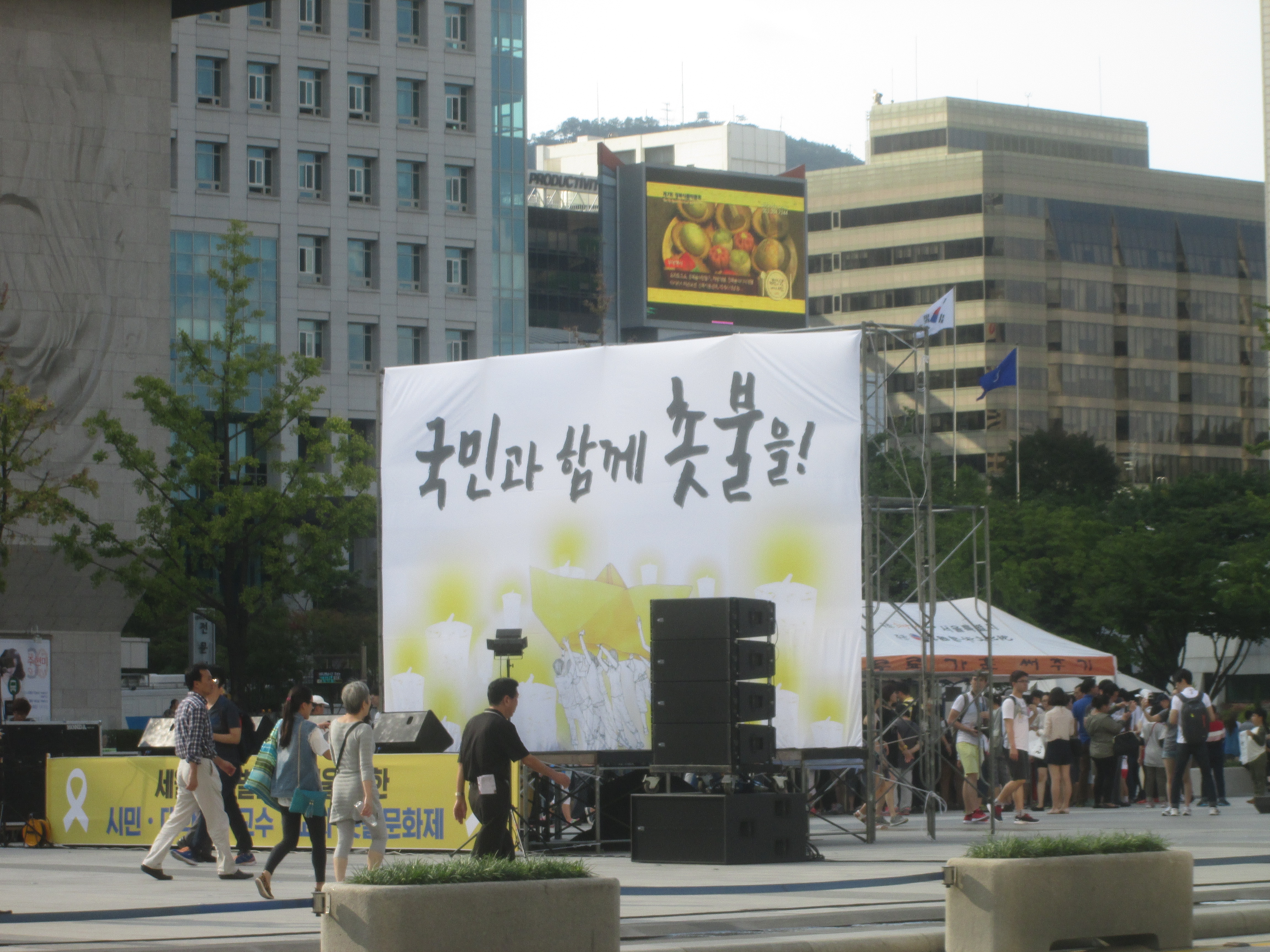
A stage for a candlelight vigil being erected next to a crowded booth giving away inspirational calligraphic inscriptions for the family. Photo courtesy Samuel Collins
their many supporters, all of whom have been waging a lengthy and highly visible protest in Seoul’s plazas since spring of 2014. In addition, there have been protests from a right-wing group as well, one whose smaller numbers are belied by the attention given them by the conservative press. Finally, there has been a continuous series of events and entertainments at the Plaza during the same period—sometimes these have been consonant with the Sewol protests, as in the August 2014 visit from Pope Francis where he articulated his support for the Sewol families. More often, however, the events have been disconnected—unlikely bedfellows sharing the same space.
Online Spatial Practice
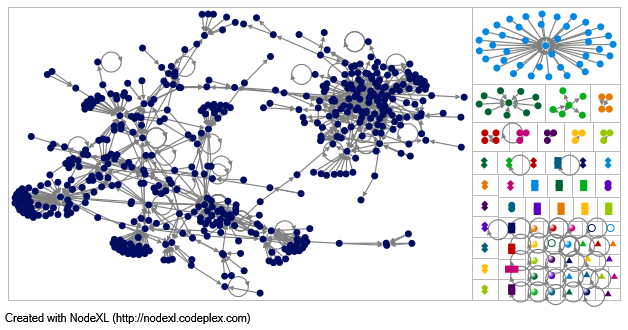
Back in the Twitterverse, I used NodeXL to download twitter data from September 11-13 (2014) using the keyword “Gwanghwamun” (광화문). Stripped of identifying labels and grouped by connected components, the search yielded about 700 nodes (Twitter accounts) connected to each other by over 1000 edges.
Graph courtesy Samuel Collins
Based on the graph, we can see several different events and/or groups, all utilizing the plaza at the same time. The clusters in the largest box are tweets regarding the Sewol protests, with the large cluster on the left side of the box associated with the Sewol families, and to the right the right-wing group against any special investigation into the Sewol ferry disaster. On the right of the graph are a series of smaller boxes, declining in number to isolated self-tweets at the bottom. These smaller, disconnected clusters are broadcasting events in Gwanghwamun Square; the smallest are personal messages (“Meet me at Gwanghwamun Square”).

Sewol protestors in different tents along Gwanghwamun Plaza. Photo courtesy Samuel Collins
What’s important here is that these different elements reflect different kinds of spatial practice. In the Marc Smith et al model, the first type, the broadcast network, shows itself in a typical radial pattern—the organizers broadcasting their event. Accordingly, people at these events (free calligraphy, performance or concerts) came as individual consumers (whether singly or on units of family and friends). They lined up to consume at different booths, and having consumed the event, went their separate ways—the plaza practiced according to the spectacle of tourism and consumption.
The Sewol protest shows clusters of tightly connected Twitter accounts, linked by multiple connections between them. This seems somewhere between a community cluster (within the coalition of Sewol protestors) and a polarized crowd (between the protesters on the left and the right-wing group on the right). Physically, the Sewol activists are likewise divided into coalitions (for example, religious groups supporting the Sewol families), each of which occupies separate tents along Gwanghwamun Plaza. On the other hand, the right-wing encampment is down the plaza and across the street—occupying one tent. Moreover, the Sewol protest camp involves different groups each enacting different forms of social activism (fasting, praying, etc.) towards a common goal of legislative change.
The point here is not to make any easy predictions about what spatial practice might look like based on Twitter networks, but to suggest that those intersections may constitute a rich source of data for anthropological investigation, mutually enforcing patterns of practice across both physical and virtual spaces that may not tell us much about big data, but may reveal something of local practices of social media.
[Originally published in http://www.anthropology-news.org/index.php/2014/09/22/twitter-on-the-plaza/]